I am coming up on one of the most significant anniversaries of my post-college life thus far. In just over a month, it will have been a year since I started writing fiction again, and the confluence of circumstances that got me started and kept me going was just so perfect that it resists easy itemization. Nonetheless, I'm going to try. For the curious, this article is what prompted me to finally write all this down.
1) Audience.
When I was in middle school, I started sending my writing out. Not to literary magazines or contests, but to my relatives and to a handpicked list of teachers and family friends. The feedback I received kept me going. I immersed myself in a series of film noir pastiche stories and taught myself A plots and B plots and episodic vs. serial arcs, knowing that (either out of kindness to me or genuine interest in the story; the distinction didn't bother me that much) someone was waiting to know what happened next. The praise was nice, and continued through high school, because that's what you do when a middle schooler or high schooler demonstrates a commitment to something: you praise them. The praise was nice, but the audience of readers was even nicer. Even after I stopped with the regular mailings in freshman year of high school, I still benefited from a vocal and supportive audience for my writing. My audience that gave feedback, that indulged me as I worked through character developments out loud. I allowed my characters and plots to grow in depth and complexity, not because I was making any conscious effort to grow as a writer, but because those were the types of stories that genuinely interested my audience. The length of time between a conversation's start and an audience member's glazed eyes and lack of attention grew.
A quick word on praise: I almost want to say that it doesn't have to be genuine. Not at first. Not when the first draft could still wither on the vine. I've talked with K a lot about this. She's a teacher, and believes in the necessity of positive reinforcement, especially at the beginning of things. I don't think that need ends with adulthood. If anything, it gets worse, because adults have the tendency to second guess everything.
In sum, tell me my idea sounds interesting, with great characters. Tell me that you can't wait to read the rest. Then, when there is a story, when it's done and there's a beginning, middle, and end, and I'm debating the possibility of sharing it with a broader audience...that's where the audience comes in. Tear it to shreds. We'll call it editing.
Writing is a very solitary pursuit. To a certain extent, at least for me, it has to be. I get distracted easily. Once I get in the groove, it's important to keep going. Nonetheless, it is equally important to pop the bubble occasionally and ask, "Is this working for people?" "Does this interest anyone besides me?"
Writers without readers are diarists, and I was never very good at keeping a diary.
2) Accountability.
This is about more than just an audience. This is about a person (or concept, I guess), who is relying on you to deliver. Playing the Letter Game went like this: K would send me her installment. A day would pass. Two days. Seven. Suddenly, I would start to feel itchy. She was waiting for me to respond. Worse, I wouldn't get to hear what happened to her characters until I let her know what happened to mine. Suddenly, procrastination was not an option. I wrote. The plot threads intertwined. Our separate plot lines united to advance the greater story. Procrastination wasn't even a consideration. The week-long turnaround periods became four days. Then three. Then twenty-four hours.
The Letter Game gave me a person who, more than looking forward to reading my writing, would be disappointed when I wasn't writing. The larger takeaway was that I have to have a reason outside of myself to keep writing. Working toward some large, amorphous I Will Be A Writer goal just doesn't cut it. Not yet, anyway.
3) Interest.
It may seem painfully obvious, but if you're not interested in the story you're telling, you honestly can't be surprised when no one else is. I remember writing only one of the stories I brought to writing workshops at Princeton, and it was one I started writing off-campus the previous summer, out of genuine interest in the subject. As the the other stories I wrote there, if I wrack my brain I can think of a vague plot, one or two characters, or a general hook ("The one with the good sexual tension." The one with the old people."), but not much else. I can't even remember where I was sitting when I wrote these, let alone what I was feeling. That tells me my heart wasn't in it.
I've talked here before about Writing to Solve Problems, which is, in general, what works best for me. The interest has to run on every level: the problem, the resolution (or even, but more rarely, the solution), and the plot and characters who will take you there. Gay seminarians. Long-lost godfathers. What the world will look like deep in the future, how we've moved forward, how we've slid back, and how the people there continue to live with themselves.
4) Feeling.
Every time--and I mean every time--I take the Myers Briggs test, I come out INFJ. Every description ever written speaks to the depths of my soul. It makes sense, therefore, that feeling (that's what the "F" stands for) rather than thinking my way through a story is the best approach. This is as related to interest as accountability was to audience. The problem may be compelling, and I may have a vested interest in its solution, but if I can't fire on all empathy cylinders straight into a feel for the character, then it's not happening. If I'm not driving with the radio on and don't occasionally get punched in the gut by how perfect a certain song is, not from my own perspective, but from the character's perspective, then it's not happening.
The Letter Game was great for this because, for two hours or so every other day, or however long it takes you to respond, you are that character. You may not share their views, or their history, but if you can't put yourself in their shoes and believe what they believe for two hours or so every other day, then your Letter Game won't take off, eat your brain, steal your heart, etc.
If I can't make myself cry, crack myself up, or get myself so tense that I'm moved to administer an awkward self-massage, then it's not happening.
5) No plan? No problem!
This is where the article comes in. For three years in college and one year after graduation, I had this stupid idea that I had to write to an outline. Why? Lord knows. I never had before, and I never had a problem with focus, drive, or creativity. Probably someone told me. Maybe it was an experiment. Either way, I should have stopped immediately and gone back to my old passion-driven scattershot ways. Only I didn't, because I didn't realize my writing process was a process you could wreck, and by the time it was wrecked, it was really wrecked, on multiple fronts (see above; I no longer had access to any of those things).
The Letter Game was tailor-made for a writer like me. You have to start at the beginning and write your way through. (That means no skipping around and writing your favorite parts and giving up before you get to the connective tissue out of some misguided assumption that connective tissue is boring.) You can't outline anything even if you wanted to, because at any moment your co-writer could veer off in an entirely different direction and you have to be ready to roll with it.
For the first time in four years, I finished something, and it happened because, right up until the last sentence, which fell on me fully formed from on high while I was in the shower (go figure), I didn't know where it was going until it got there.
Of course, it's not entirely finished, not really, because writing is never finished and because we're intensively editing now, and probably will be for at least another year. It's not finished, because if it's finished I have to ask myself what the next project is, and although I have several ideas, that's still a question that scares me.
Scares me, but not in a hopeless way. In an excited way. Because now I realize that with an audience, with someone holding me accountable, with genuine interest in the story and a real feel for the characters, and, finally, with absolutely no idea where I'm headed, I can't go wrong.
Wednesday, October 9, 2013

Wednesday, September 18, 2013
How I Read (Now)
Over the past year, I've noticed a pretty significant change in how I read. It's not just in the books I choose to read (although I have been choosing slightly differently, it's true) but in the way I read them. Instead of latching onto characters who entertain, I've found myself latching on to characters to emulate. The scenes that I've found most moving are the scenes when a character is facing a situation. A decision. Facts about themselves or others they can no longer ignore. It's never that the character is a role model (or, at least, very rarely is the character a role model), but rather that there are elements of the character I aspire to: flexibility, fortitude, empathy.
Maybe they are role models. No one has ever thought they'd like to replicate every single trait someone else possesses, right?
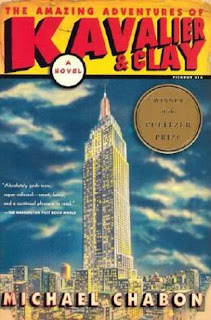 I started thinking about this after finishing The Amazing Adventures of Kavalier & Clay, which is unquestionably this year's Cloud Atlas, albeit without a movie or a soundtrack to buoy the obsession along. This is a book I put off reading for years, because I had heard it was sad, and because I was at a low ebb in my interest in reading "immigrant stories" and blah blah blah.
I'm glad I waited. Waiting meant that I didn't read this book as a high school student, when I probably would have focused exclusively on Sammy's story, or as a college student, when I would have felt the need to keep a running tally of every cameo by a historical figure. Instead, here I am, in this new phase of my reading life, feeling as if I too could scale the Empire State Building or brave Antarctica, just because these characters did and because in them, in pockets, I could see a little of myself and I would most like to be.
This isn't an entirely new concept. When I moved to Chicago I brought books featuring Dido Twite, Mary Ann Singleton, and George Smiley, thinking these were the characters who would stand me in good stead in my new life. I was right, even though I didn't crack the spine and re-read any of these books until I had already been here for two years and the roughest days were behind me. There were actually days when I asked myself what they would do. Dido walked me through rough neighborhoods. Mary Ann got me out of the house on weeknights. George kept me questioning the status quo.
More frequently, I asked myself what my father would do. But most of the time that was in reference to getting the best parking spot.
Maybe they are role models. No one has ever thought they'd like to replicate every single trait someone else possesses, right?
 I started thinking about this after finishing The Amazing Adventures of Kavalier & Clay, which is unquestionably this year's Cloud Atlas, albeit without a movie or a soundtrack to buoy the obsession along. This is a book I put off reading for years, because I had heard it was sad, and because I was at a low ebb in my interest in reading "immigrant stories" and blah blah blah.
I'm glad I waited. Waiting meant that I didn't read this book as a high school student, when I probably would have focused exclusively on Sammy's story, or as a college student, when I would have felt the need to keep a running tally of every cameo by a historical figure. Instead, here I am, in this new phase of my reading life, feeling as if I too could scale the Empire State Building or brave Antarctica, just because these characters did and because in them, in pockets, I could see a little of myself and I would most like to be.
This isn't an entirely new concept. When I moved to Chicago I brought books featuring Dido Twite, Mary Ann Singleton, and George Smiley, thinking these were the characters who would stand me in good stead in my new life. I was right, even though I didn't crack the spine and re-read any of these books until I had already been here for two years and the roughest days were behind me. There were actually days when I asked myself what they would do. Dido walked me through rough neighborhoods. Mary Ann got me out of the house on weeknights. George kept me questioning the status quo.
More frequently, I asked myself what my father would do. But most of the time that was in reference to getting the best parking spot.
Wednesday, August 21, 2013
1178th Most Happy
I'm back!
In general, as is the case today, it's a good sign when I don't blog for weeks on end. It means I'm writing something else. Fortunately, it doesn't follow that because I'm back I'm no longer writing that other thing. On the contrary.
I was starting to feel guilty, though, neglecting My Kind of Fool for so long. And, of course, I had this to share with you:


In general, as is the case today, it's a good sign when I don't blog for weeks on end. It means I'm writing something else. Fortunately, it doesn't follow that because I'm back I'm no longer writing that other thing. On the contrary.
I was starting to feel guilty, though, neglecting My Kind of Fool for so long. And, of course, I had this to share with you:
Has anything more accurate ever been written? How did they know I was 66-100 years old?!
In other news, I love my new apartment. I can sleep. I can no longer identify every pair of shoes my neighbors own. I felt so grown up and footloose that I bought a TV. Sure, the internet is not as reliable as it once was, but I can live with that. It gives me more time to read and, more importantly, write.
Saturday, July 6, 2013
Moving
Mom came to visit me over the Mother's Day weekend, and it was a great visit, one of the best of all time. (I would even go as far as to say it surpassed Dad Visits and We Go to a Wedding, Part One and tied Subcontinent and Sir U von L Honorary St. Patty's Day and Architecture Boat Tour Extravaganza.) But it was a long time ago now and I've had a couple more visitors since then. Next weekend, I'll have my last visitor to this apartment. Appropriately, it's going to be CC, college roommate extraordinaire.
Last visitor to this apartment, you say? Why yes. On August 1st, I'm moving on to bigger and better things in the form of a one bedroom a stone's throw from here. In one of the best coincidences so far, it will be on the same street as where my aunt lived when she first lived in Chicago, two blocks down.
This is the seventh summer in a row that I've moved. The first five times (moving to college, and then moving back and forth between home and new dorm rooms) were carried out under my own steam and I got so good at it that by the end I was turning down help and packing up my car with scientific precision as my parents (absent for the three previous departures) looking on, impressed, and held my diploma.
Last summer, I wasn't moving myself, and it was the trickiest move of all. In 108 degree heat, I helped my parents move into their new house in Lawrence, Kansas. It was the hardest move, but it was also the best, because the payoff was the greatest. When we hung the corn painting above their fireplace and it instantly fit, I could tell they'd found a great new home.
So last summer I didn't actually move myself. There was no way I was moving apartments in the same month as I was helping my parents move houses. Nonetheless, I was getting sicker and sicker of living in a studio (especially with visitors, no matter how beloved, and especially in winter).
The move this summer is going to be hectic. (It falls at the end of our yearly trip to Colorado.) It's going to be hot. (See: August 1st. Also it's a third floor walk-up.) But, it's going to be worth it.
Last visitor to this apartment, you say? Why yes. On August 1st, I'm moving on to bigger and better things in the form of a one bedroom a stone's throw from here. In one of the best coincidences so far, it will be on the same street as where my aunt lived when she first lived in Chicago, two blocks down.
This is the seventh summer in a row that I've moved. The first five times (moving to college, and then moving back and forth between home and new dorm rooms) were carried out under my own steam and I got so good at it that by the end I was turning down help and packing up my car with scientific precision as my parents (absent for the three previous departures) looking on, impressed, and held my diploma.
Last summer, I wasn't moving myself, and it was the trickiest move of all. In 108 degree heat, I helped my parents move into their new house in Lawrence, Kansas. It was the hardest move, but it was also the best, because the payoff was the greatest. When we hung the corn painting above their fireplace and it instantly fit, I could tell they'd found a great new home.
So last summer I didn't actually move myself. There was no way I was moving apartments in the same month as I was helping my parents move houses. Nonetheless, I was getting sicker and sicker of living in a studio (especially with visitors, no matter how beloved, and especially in winter).
The move this summer is going to be hectic. (It falls at the end of our yearly trip to Colorado.) It's going to be hot. (See: August 1st. Also it's a third floor walk-up.) But, it's going to be worth it.
Sunday, May 5, 2013
"Of course it's all trash..."
Sometimes my friends have more faith in me than I have in myself. Several times since he moved to Chicago, R has introduced me to friends of his as a writer. As "one hell of a writer." As "an amazing playwright." Just as frequently, K has reminded me of stories I wrote in creative writing in high school, quoting them word for word. (I had to dredge up the document to fact-check her and, sure enough, she was right.)
This morning, I was reading Christopher and His Kind by Christopher Isherwood (I finished it this afternoon, under a flowering tree), and came across the following excerpt of a letter from his friend Edward Upward:
Those of us who have friends like R and K, and Edward Upward, are the lucky ones. These are the friends who don't believe our nonsense when we say we're headed in a different direction. They insist on continuing to see us as our best selves. It's not that they're inflexible in their conception of our identity, rather they see through all our bluster to the core of what makes us us.
During the Summer of Angst and the following years, I asked myself, "If I'm not a writer, and I've spent my entire life since fifth grade thinking of myself as a writer, then who am I?" I never did come up with a satisfactory answer. Thank goodness. And thank goodness I'm surrounded by people who love me and know better.
This morning, I was reading Christopher and His Kind by Christopher Isherwood (I finished it this afternoon, under a flowering tree), and came across the following excerpt of a letter from his friend Edward Upward:
Olive showed me your letter in which you said something about being silently judged. Of course it's all trash, because--though Marx may not have said it--each of us helps the revolution best by using his own weapons. And your best weapon is obviously writing. It's my misfortune that I have to fight as a fifth-rate teacher.
Those of us who have friends like R and K, and Edward Upward, are the lucky ones. These are the friends who don't believe our nonsense when we say we're headed in a different direction. They insist on continuing to see us as our best selves. It's not that they're inflexible in their conception of our identity, rather they see through all our bluster to the core of what makes us us.
During the Summer of Angst and the following years, I asked myself, "If I'm not a writer, and I've spent my entire life since fifth grade thinking of myself as a writer, then who am I?" I never did come up with a satisfactory answer. Thank goodness. And thank goodness I'm surrounded by people who love me and know better.
Saturday, April 6, 2013
Why Roger Ebert Was My Hero (and other facts)
I've been filling out the Proust Questionnaire pretty much yearly since early in my college career. I never consult previous years' responses while I fill it out, although I do compare answers afterward. Each year, for the years that I've done it, I've listed Roger Ebert as one of my heroes.
"The story can either be told in a few sentences, or not told at all."
Because he was kind.
I never met the guy, despite having lived in one of his
towns for all but 4 ½ years of my life. I never made it to Ebertfest. (Where was I last year and why didn’t I go?) However, I believe
that an unkind man would be unable to capture the tone Ebert did from time to
time in his reviews and blog entries. He was a secular humanist. He had
wide-ranging sympathies. He had made his mistakes and learned from them. He
appeared not to have any regrets.
“Both Curtis and Lemmon are practicing cruel
deceptions--Curtis has Monroe thinking she's met a millionaire, and Brown
thinks Lemmon is a woman--but the film dances free before anyone gets hurt.
Both Monroe and Brown learn the truth and don't care, and after Lemmon reveals
he's a man, Brown delivers the best curtain line in the movies. If you've seen
the movie, you know what it is, and if you haven't, you deserve to hear it for
the first time from him.”
Because he was from Urbana and he wasn’t afraid to love
it.
Everyone in Chicago, from the Tribune (ha!) to the Sun-Times and all the rest, ran to present Ebert as the
ultimate post-Studs Terkel Chicagoan. That may be true, but he did
Champaign-Urbana proud too. He was intelligent, unpretentious, down to earth,
self-deprecating, and funny. Again and again in his writing (even in his
reviewing), he held up moments from his childhood in Urbana as significant. He
didn’t write it off as “downstate,” reduce it to a college town, or fixate on
the corn and soybeans. He lived in Chicago and, yes, he was a Chicagoan, but
Champaign-Urbana got the film festival, because where else would it be? Home is
home.
"On the news last week, there was the story of a child
killed by stray gunfire. He was in the middle of a basketball game in a city
park. One of his teammates told the camera: "It's a shame he never had the
experience of life." There are fuzzy shots of a surveillance camera
showing a white car with a sunroof speeding from the site. Inside were probably
young men empowered by firearms and an automobile to shoot stupidly into a park
and make a pathetic gang gesture. The Interrupters were once such young men —
and women. They once were blind, but now they see. […] When I was a child, I
rode my bike home from school down a daily network of neighborhood streets. On
one street, some kids were sitting on a porch. They pulled me off my bike,
punched me and told me it was "their" street. They were white like
me. They had no idea what school I went to. By protecting "their"
street, they were gaining esteem. I have no doubt they felt good afterward."
Because he was serene in the face of illness.
What could have been the end of his career marked a new
period of intense prolificacy and, I think, beautiful writing. He grappled with
big questions with humor and perspective. He got frustrated. He was human. He
made accommodations. He kept doing his job.
“The reason that O'Brian's readers are so faithful (I am
one) is because this friendship provides him with a way to voice and consider
the unnatural life of a man at sea: By talking with each other, the two men
talk to us about the contest between man's need to dominate, and his desire to
reflect.”
Because he could write.
This is the kind of writer I want to be: insightful,
approachable, populist. He was a smart man, and it showed. He was funny.
“As a director he has never been willing to settle for
plot; he is much more interested in character and situation, and likes to
assemble unusual people in peculiar situations and stir the pot.”
Because he had great taste in movies.
And I don’t just mean fine taste. I mean he liked what he
liked unapologetically, and 90% of the time I agreed with him. He was just as
likely to give an art-house film four stars as a blockbuster. He cared about
things like acting, direction, script, and cinematography, and whether it came
with millions of dollars of visual effects or whether it was subtitled or
whether it was for children didn’t matter. He disliked a lot of movies, but he
only hated the ones that really deserved it.
“By the end of the movie, you find yourself reacting to
the weddings, and the funeral, almost as you do at real events involving people
you didn't know very well, but liked, and wanted to know better.”
Wednesday, April 3, 2013
"And to do that, you have to let yourself get hooked."
Beginning in April 2007, I started keeping a list of all the books I'd read the
previous year. You can find links to previous years at the bottom of this entry. Without further ado, welcome to 2012-2013, the Year of David Mitchell (or: 26 Books, 17 Authors).
Books
1) Affinity by Sarah Waters
2) The Inner Voice of Love by Henri J.M. Nouwen
3) Lord John and the Scottish Prisoner by Diana Gabaldon
4) Following Christopher Creed by Carol Plum-Ucci
5) The Game of Kings by Dorothy Dunnett*
6) Queens' Play by Dorothy Dunnett*
7) Quiet: The Power of Introverts in a World That Can't Stop Talking by Susan Cain
8) The Disorderly Knights by Dorothy Dunnett*
9) Cloud Atlas by David Mitchell
10) The Thousand Autumns of Jacob de Zoet by David Mitchell
11) Ghostwritten by David Mitchell
12) Black Swan Green by David Mitchell
13) People by Alan Bennett
14) A Wrinkle in Time by Madeleine L'Engle*
15) A Wind in the Door by Madeleine L'Engle*
16) A Swiftly Tilting Planet by Madeleine L'Engle*
17) Many Waters by Madeleine L'Engle*
18) number9dream by David Mitchell
19) Lions and Shadows: An Education in the Twenties by Christopher Isherwood
20) Will Grayson, Will Grayson by John Green and David Levithan
21) Tell the Wolves I'm Home by Carol Rifka Brunt
22) We Have Always Lived in the Castle by Shirley Jackson
23) Running the Books: The Adventures of an Accidental Prison Librarian by Avi Steinberg
24) Gettysburg: The Graphic Novel by C.M. Butzer
25) Down There on a Visit by Christopher Isherwood
26) A Dublin Carol by Conor McPherson
*re-reads
I have continued the trend of reading fewer and fewer books since graduating from college. Although only being able to list 26 books here depresses me, there is cause for hope! So far, I am only 3 books behind my 50-book challenge for 2013, and several of these were read as a direct result of the pressure to keep up with that challenge.
It may well be that I chose my books more carefully this year. It was, after all, a year of author binges and re-reads. Looking over this list now, there are only four I would not re-read, given the chance, and none that inspired the kind of dislike I've felt for books on the list in the past. It was also, my mother would urge me to point out, a good year for female authors.
Top Five of the Year, in descending order
Cloud Atlas by David Mitchell
Down There on a Visit by Christopher Isherwood
The Thousand Autumns of Jacob de Zoet by David Mitchell
Running the Books: The Adventures of an Accidental Prison Librarian by Avi Steinberg
Tell the Wolves I'm Home by Carol Rifka Brunt
Past years
2011-2012
2010-2011
2009-2010
2008-2009
2007-2008
Books
1) Affinity by Sarah Waters
2) The Inner Voice of Love by Henri J.M. Nouwen
3) Lord John and the Scottish Prisoner by Diana Gabaldon
4) Following Christopher Creed by Carol Plum-Ucci
5) The Game of Kings by Dorothy Dunnett*
6) Queens' Play by Dorothy Dunnett*
7) Quiet: The Power of Introverts in a World That Can't Stop Talking by Susan Cain
8) The Disorderly Knights by Dorothy Dunnett*
9) Cloud Atlas by David Mitchell
10) The Thousand Autumns of Jacob de Zoet by David Mitchell
11) Ghostwritten by David Mitchell
12) Black Swan Green by David Mitchell
13) People by Alan Bennett
14) A Wrinkle in Time by Madeleine L'Engle*
15) A Wind in the Door by Madeleine L'Engle*
16) A Swiftly Tilting Planet by Madeleine L'Engle*
17) Many Waters by Madeleine L'Engle*
18) number9dream by David Mitchell
19) Lions and Shadows: An Education in the Twenties by Christopher Isherwood
20) Will Grayson, Will Grayson by John Green and David Levithan
21) Tell the Wolves I'm Home by Carol Rifka Brunt
22) We Have Always Lived in the Castle by Shirley Jackson
23) Running the Books: The Adventures of an Accidental Prison Librarian by Avi Steinberg
24) Gettysburg: The Graphic Novel by C.M. Butzer
25) Down There on a Visit by Christopher Isherwood
26) A Dublin Carol by Conor McPherson
*re-reads
I have continued the trend of reading fewer and fewer books since graduating from college. Although only being able to list 26 books here depresses me, there is cause for hope! So far, I am only 3 books behind my 50-book challenge for 2013, and several of these were read as a direct result of the pressure to keep up with that challenge.
It may well be that I chose my books more carefully this year. It was, after all, a year of author binges and re-reads. Looking over this list now, there are only four I would not re-read, given the chance, and none that inspired the kind of dislike I've felt for books on the list in the past. It was also, my mother would urge me to point out, a good year for female authors.
Top Five of the Year, in descending order
Cloud Atlas by David Mitchell
Down There on a Visit by Christopher Isherwood
The Thousand Autumns of Jacob de Zoet by David Mitchell
Running the Books: The Adventures of an Accidental Prison Librarian by Avi Steinberg
Tell the Wolves I'm Home by Carol Rifka Brunt
Past years
2011-2012
2010-2011
2009-2010
2008-2009
2007-2008
Subscribe to:
Posts (Atom)